Why Is Britain's Factory Rebound Riding On Strategic Stockpiling?
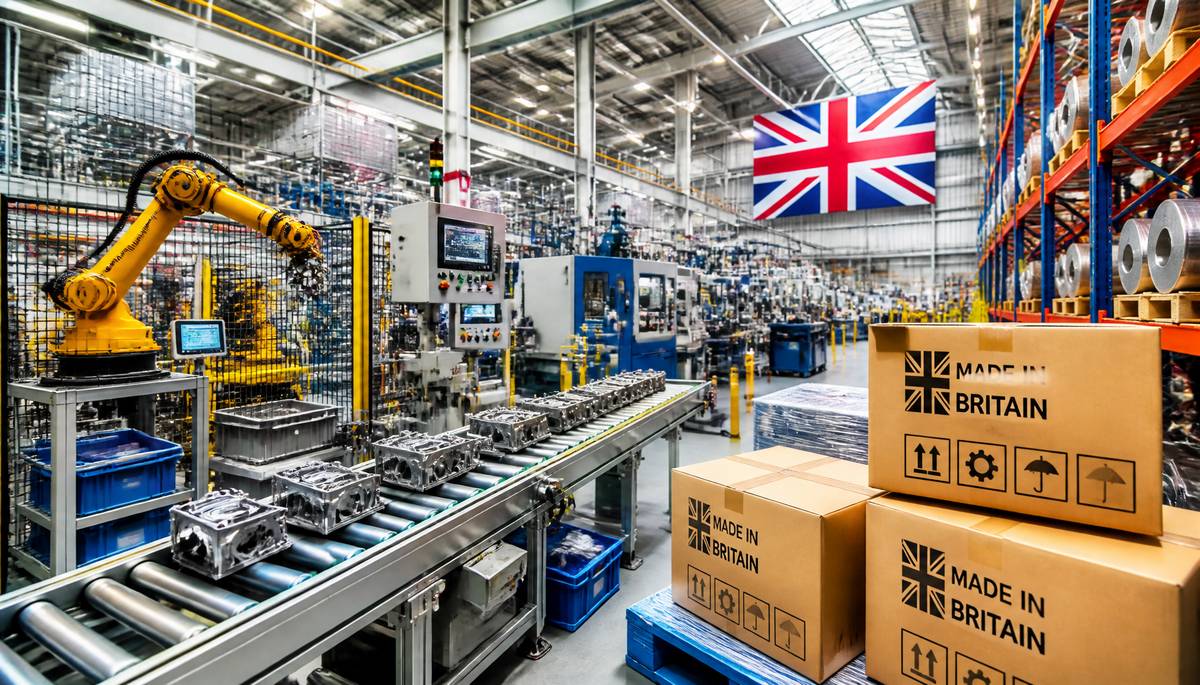
A recovery with an asterisk Britain’s manufacturing revival has acquired an intriguing and slightly uneasy companion: strategic stockpiling. Factories are indeed busier. Output in June grew at its quickest rate for 21 months, and the sector has now remained in expansion territory for eight consecutive months. Yet the question hanging over this improvement is not simply how strong it is, but how durable. If much of today’s activity is being pulled forward by customers anxious about disruption, higher prices and delayed deliveries, tomorrow may prove rather quieter.
The latest S&P Global UK Manufacturing PMI came in at 52.5 in June. That is comfortably above the 50 mark that separates growth from contraction, though it was lower than May’s 53.9, which had been the strongest reading in four years. It also slipped below the earlier flash estimate of 53.1. So the picture is not one of collapse, far from it, but of an expansion that remains real while becoming a little less brisk.
Production itself was the brightest feature. Manufacturing output rose at the fastest pace since September 2024, making June the third month in a row to record higher production levels. That increase was helped by stronger inflows of new business, some improved confidence in the market and, in certain cases, the sort of promotional activity that can coax hesitant customers into placing orders. Consumer goods and intermediate goods manufacturers saw most of the benefit. Producers of investment goods, however, continued to lag behind, which suggests that longer-term corporate spending plans are still being handled with caution.
Stockpiling is helping, but it is not a permanent engine The striking point is that part of this upswing appears to rest on defensive behaviour rather than straightforward optimism. Clients have been building inventories to protect themselves against supply chain snags and anticipated cost increases. It is understandable enough. If shipping is unreliable, materials are scarce and prices look likely to rise, buying sooner rather than later can seem prudent. The trouble is that this sort of demand has a borrowed quality. It flatters the present by raiding the future.
That concern is visible in the orders data. New business increased for a seventh straight month in June, but the pace of that growth slowed to its weakest since December 2025. Export orders also rose, extending their current run to six months, yet here too the gain was modest and the slowest of the sequence. There is still movement, then, but less urgency.
Overseas demand brought some encouragement. Manufacturers reported better sales prospects in mainland China, the European Union and the United States, all of which helped support exports. Even so, companies also pointed to stalled opportunities in the Middle East, where continuing conflict has interrupted what might otherwise have been a useful outlet for British goods. One region lends support; another withholds it. Such is modern trade.
Longer lead times are not a sign of health A further complication lies in the supply chain itself. Four of the five main PMI components still pointed towards improving conditions in June. Output, new orders and employment all increased, while supplier delivery times lengthened. On paper, slower deliveries can sometimes accompany strong demand. In this instance, however, the evidence suggests something less cheerful: bottlenecks.
Manufacturers reported a familiar catalogue of hindrances, including shipping delays, shortages of materials, regulatory friction, tariff-related disruption and constraints among suppliers. Purchasing inventories actually fell during June after rising previously, which hints that firms are not finding it entirely easy to maintain the buffers they might prefer. A rebound built partly on stockpiling becomes more precarious when the systems feeding those stocks remain unreliable.
Business confidence reflects that ambiguity. Nearly half of manufacturers, 48 per cent, expect output to rise over the coming year. That is not bleak, but neither is it especially buoyant, particularly since it sits slightly below the combined share of firms expecting no change or a decline. In other words, optimism exists, but it is not dominant.
Those who do expect growth point to sensible enough reasons: fresh openings in the market, planned product launches, wider use of technologies such as artificial intelligence and data centres, and hopes for steadier trading conditions. Others are taking a more defensive stance, citing geopolitical strains and uncertainty in the policy environment as reasons to consolidate rather than expand. One can hardly blame them. Hiring trends tell a similar story. Employment rose for a third month running, but only modestly. Some firms are recruiting because output and orders have improved; others are freezing headcount and trimming costs as input prices rise and visibility remains poor.
Britain’s factory rebound, then, is genuine but qualified. The machines are humming more energetically than they have in many months, yet some of that energy comes from precaution rather than conviction. Strategic stockpiling can provide a timely boost, but it is not a foundation on which to build a lasting industrial renaissance. For that, manufacturers will need steadier demand, cleaner supply chains and a little more confidence that the next quarter will not undo the gains of the last.
|
|